the art of game design
My top 3 lenses
· by Aron Kovacs

The question: 'What is a game?' - has long been bugging me. That's why I've asked a friend to recommend me a good book on the subject and I have to say, it took me quite a while to get through. But after a couple of years, I finally got to the end. And this book did not disappoint! Thanks Bence.
Although I must say I am not happy with the definition of game in the book:
"A game is any problem solving activity approached with a playful attitude."
I found this tautology a little too vague. So my search for what exactly is a game will continue…
Nevertheless, this book had so many lessons in it. To be precise it has a hundred lenses. And with each lens, this book provided a deep different perspective. Now, to sum up, a hundred lenses would be a little silly. So I asked myself the question if I were to take only three lenses what would I take? And I have come up in order with these three:
- The lens of unification
- The lens of indirect control
- And the lens of interest curves
I will go into detail with all three below.
Lens #9: The Lens of Unification
Skyrim is still one of my favorite games after a decade. For me, this was the first open-world RPG, the first game where I could wander around. Me and my friend wandered around for hours and hours in this fantasy world creating all sorts of experiences. Sieging cities, encountering random dragons, and going deep into the underground to fight dwarf robots. This was just the perfect place to be. It had intricate skill-building stuff, many roles to play around, and many quests waiting to unfold. But I say apart from the breadth and depth, this masterpiece had something more to offer. These individual elements transcended each other and became this one thing, a unified theme.
Well, that's all fine and dandy Aron, but how the heck can I unify the elements of my game? That's a great question! Let me cheat and introduce an extra lens just to answer it.
Lens #7: The Lens of the Elemental Tetrad
To unify your theme, all you have to do is to reinforce your theme in all the elements your game has. There are many ways to break down and classify them, but Jesse Schell uses these four:
- Mechanics: "These are the procedures and rules of your game."
- Story: "This is the sequence of events that unfolds in your game."
- Aesthetics: "This is how your game looks, sounds, smells, tastes, and feels."
- Technology: "We are not exclusively referring to 'high technology' here, but to any materials and interactions that make your game possible such as paper and pencil, plastic chits, or high-powered lasers."
To create magic you should try to sync all these categories and unify your theme. This is the first and most important lens because the sum is greater than the pieces. Reverse engineer your game and think about the sum first.
And with that said let's dive into the next lens.
Lens #72: The Lens of Indirect Control
But no matter how much freedom you enable, it is crucial that you still control the player's experience to create magic. There are many ways to do this subtly. You can use constraints, goals, the interface itself, visual design, characters, and even music to nudge a player.
Some questions to help you ignite that spark:
- Ideally, what would I like the players to do?
- Can I set constraints to get players to do it?
- Can I set goals to get players to do it?
- Can I design my interface to get players to do it?
- Can I use visual design to get players to do it?
- Can I use in-game characters to get players to do it?
- Can I use music or sound to get players to do it?
- Is there some other method I can use to coerce players toward ideal behavior without impinging on their feeling of freedom?
And last but not least the final lens:
Lens #61: The Lens of the Interest Curve
If you look at the average number of deaths in the game: Half Life, you'll find that the number is increasing.
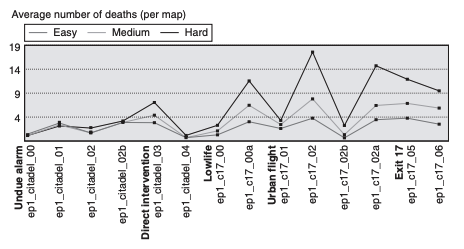
In essence, this is the interest curve. To understand this better let's imagine now your hand. As the interest curve rises you squeeze your hand to a fist. And when it drops you let go and rest your hand naturally. This contraction and then letting go in essence is how the energy of the game should be structured. It gets gradually more and more intense but with times of rest, allowing you to recharge.
More questions from the book worth asking:
- If I draw an interest curve of my experience, how is it generally shaped?
- Does it have a hook?
- Does it have gradually rising interest, punctuated by periods of rest?
- Is there a grand finale, more interesting than everything else?
- What changes would give me a better interest curve?
- Is there a fractal structure to my interest curve? Should there be?
- Do my intuitions about the interest curve match the observed interest of the players? If I ask playtesters to draw an interest curve, what does it look like?
One final thought
But you know what? There is one more thing that's more important than all three of these lenses. And that thing is love.
At the heart of a world-class game design is love.
The meta and final lesson in the book is that no amount of lens or technical expertise will create a truly great game. Unless you have love. Love for the player, genre, medium, or the experience itself.
Because love is the thing that connects the designer and the player.